In today’s hyper-connected world, the transition from a high-pressure workday to a restorative night’s sleep is rarely automatic. Most professionals finish their day in a state of “tired but wired”—physically exhausted yet mentally overstimulated by blue light, deadlines, and the relentless stream of digital notifications. This physiological disconnect is a leading cause of insomnia and poor sleep quality, which ultimately drains our cognitive bandwidth the following day.
While many seek refuge in sleep apps or supplements, the most effective biological “off-switch” is much simpler: a targeted, five-minute restorative yoga flow. This isn’t about fitness or flexibility; it is a strategic intervention designed to down-regulate your nervous system and prepare your brain for deep, healing sleep.
The Biohacking Behind the Flow
The secret to a successful wind-down lies in the Autonomic Nervous System (ANS). Throughout the day, we predominantly operate in the “Sympathetic” state—the fight-or-flight mode. While great for productivity, staying in this state inhibits the production of melatonin and keeps cortisol levels elevated.
By engaging in specific, low-intensity movements paired with controlled breathing, you trigger the Parasympathetic Nervous System (the “rest and digest” mode). This five-minute routine acts as a neurological bridge, signaling to your body that the “threat” of the workday is over and it is safe to enter a state of recovery.
The 5-Minute “Power Down” Sequence
You can perform these movements directly on your mattress. Dim the lights, put your phone on “Do Not Disturb,” and focus entirely on the sensation of your breath.
1. Child’s Pose (Balasana) – 1 Minute
Kneel on your bed, big toes touching, and sit back on your heels. Fold forward, resting your forehead on the mattress or a pillow. Stretch your arms out in front or rest them by your sides.
The Benefit: This is the ultimate grounding posture. It gently releases tension in the lower back and hips—areas where we store physical stress from sitting. It creates a sense of “turning inward,” helping to quiet a racing mind.
2. Reclined Butterfly (Supta Baddha Konasana) – 1 Minute
Lie on your back, bring the soles of your feet together, and let your knees fall open to the sides. Place one hand on your heart and the other on your belly.
The Benefit: This pose opens the chest and hips. Focusing on the rise and fall of your hand on your belly encourages diaphragmatic breathing, which is the fastest way to hack your vagus nerve and induce calmness.
3. Supine Spinal Twist – 1 Minute
Lying on your back, hug your right knee to your chest, then gently guide it across your body to the left. Keep both shoulders flat on the bed. Hold for 30 seconds, then switch sides.
The Benefit: Twists are “detoxifying” for the spine. They help neutralize the back after a day of slouching and aid in digestion, preventing that “heavy” feeling that can sometimes keep you awake.
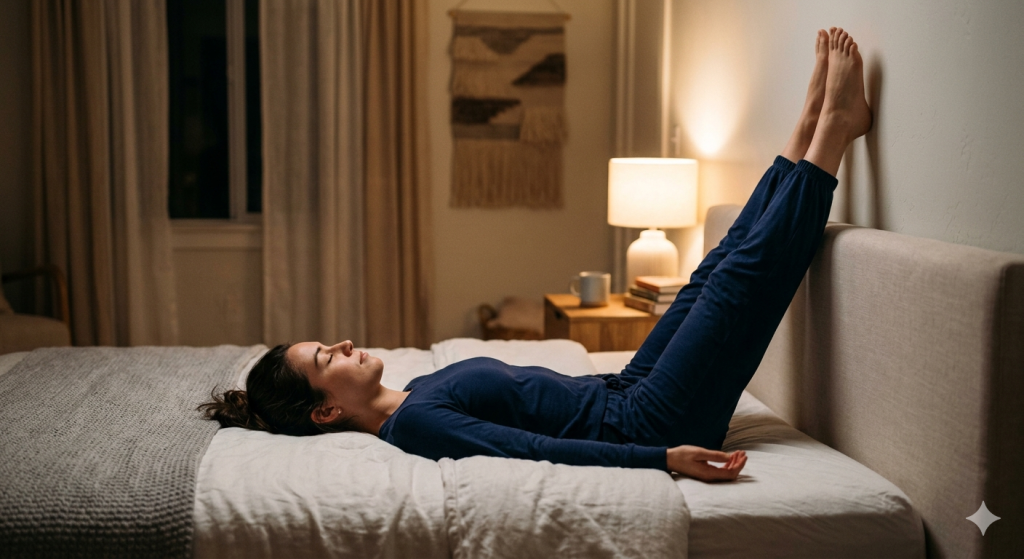
4. Legs-Up-The-Wall (Viparita Karani) – 2 Minutes
Scoot your hips as close to the headboard or wall as possible and swing your legs up vertically. Rest your arms by your sides, palms facing up.
The Benefit: This is the “holy grail” of restorative yoga. It encourages lymphatic drainage, reduces leg swelling, and significantly lowers your heart rate. It is the most effective pose for shifting the brain into a pre-sleep state.
Maximize Your Results: The “Silent” Rules
Lengthen the Exhale: During these five minutes, try to make your exhales twice as long as your inhales. This specific breathing pattern is a biological command for the heart to slow down.
Release the Jaw: We often hold tension in our jaw without realizing it. Soften your tongue and unquenchable your teeth during every pose.
Consistency over Intensity: You don’t need to be “good” at yoga for this to work. The benefit comes from the ritual of doing it every night, training your brain to recognize this sequence as the precursor to sleep.
Frequently Asked Questions (FAQ)
Q: Do I need to be flexible to do this? A: Not at all. These poses are about relaxation, not stretching. Use as many pillows as you need to feel fully supported. If a pose feels like “work,” you’re doing too much—back off until it feels like effortless rest.
Q: Can I do this even if I’ve had a few drinks? A: While alcohol generally disrupts sleep quality, a gentle flow can still help calm the nervous system. However, skip the spinal twists if you feel dizzy or nauseous.
Q: What if I fall asleep during the last pose? A: That is the ultimate goal! If you drift off during Legs-Up-The-Wall, simply roll over and go to sleep. There’s no need to “finish” the routine if your body has already reached its destination.
Q: Why only 5 minutes? A: Five minutes is the “minimum effective dose.” It’s long enough to shift your physiology but short enough that you can’t use “I’m too tired” as an excuse to skip it.
Conclusion
Quality sleep is the ultimate performance enhancer. By dedicating just five minutes to this evening flow, you are investing in your mental clarity, emotional stability, and long-term health. Stop fighting your insomnia with screens and start working with your body’s natural rhythms. Try this tonight, and experience how a small shift in movement can lead to a massive shift in the quality of your rest.