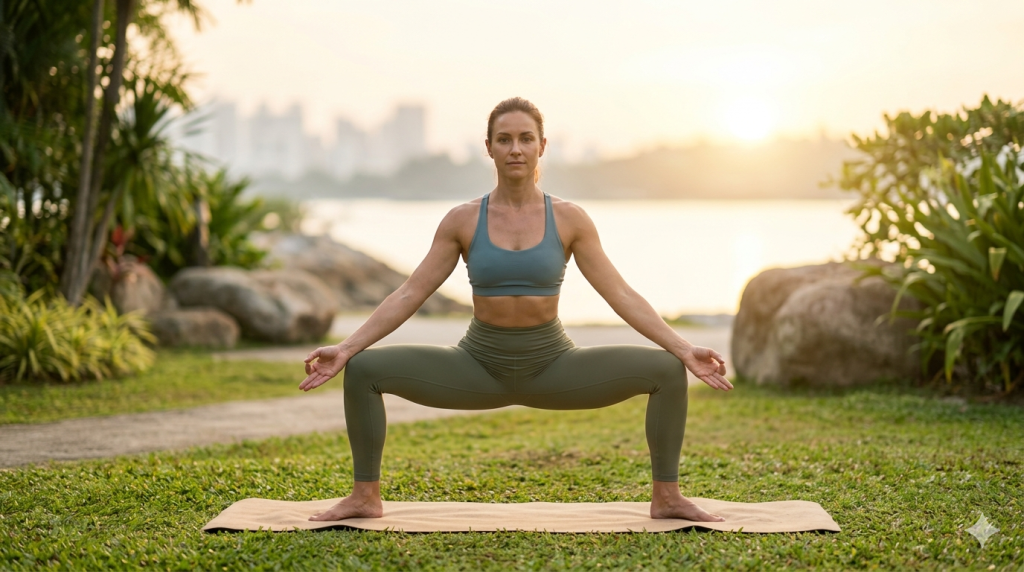
If your morning routine feels like a repetitive cycle of caffeine and scrolling, it is time to introduce a movement that does more than just stretch your muscles—it reclaims your energy. While many yoga practitioners gravitate toward the fluid grace of Sun Salutations or the meditative stillness of Child’s Pose, there is one posture frequently omitted from modern flows that offers an unparalleled blend of stability, power, and metabolic fire: the Goddess Pose (Utkata Konasana).
This isn’t just a simple wide-legged squat; it is a declaration of presence. Often overshadowed by “trendier” poses, Goddess Pose is a foundational powerhouse that targets the lower body, unlocks the hips, and builds the kind of functional resilience needed to navigate a demanding day with ease.
Why the Goddess Pose is Your Secret Weapon
In a typical 60-minute yoga class, instructors often focus on linear movements—moving forward and back along the length of the mat. However, Goddess Pose demands a lateral (sideways) opening. This unique orientation engages muscle groups that are often neglected in our daily lives, particularly the deep rotators of the hips and the stabilizers of the inner thighs.
By incorporating this pose into your first 15 minutes of being awake, you aren’t just stretching; you are engaging in “active recovery” for your nervous system. It signals your brain to move from a state of rest to a state of alert, grounded readiness.
The Anatomy of Morning Vitality
To appreciate the impact of this pose, we must look at the physiological shift it creates. When you drop your hips into a deep, wide stance, you are activating:
The Glutes and Quadriceps: As the largest muscles in the body, their activation triggers a significant metabolic boost, burning more calories and generating internal heat.
The Adductor Group (Inner Thighs): These muscles are crucial for pelvic stability. Strengthening them protects the knees and supports better alignment in walking and running.
The Core and Pelvic Floor: Maintaining an upright spine in this squat requires deep core engagement, which builds a “corset” of support around your lower back.
The Scapular Muscles: By adopting “Cactus Arms,” you retract the shoulder blades, effectively reversing the “tech-neck” posture caused by hours spent over computers and smartphones.
Mastering the Pose: A Step-by-Step Guide
The Foundation: Step your feet wide apart (about three to four feet). Turn your toes outward at a 45-degree angle.
The Descent: On an exhale, bend your knees deeply. Aim for your thighs to be parallel to the floor, but only go as low as you can while keeping your tailbone tucked slightly and your spine vertical.
The Alignment: Ensure your knees are pushing outward, tracking directly over your middle toes rather than collapsing inward.
The Upper Body: Reach your arms out at shoulder height, then bend the elbows to 90 degrees with your palms facing forward. Keep your chest open and your gaze steady.
The Breath: Practice “Ocean Breath” (Ujjayi). Inhale deeply through the nose, feeling the expansion of your ribcage, and exhale with a soft constriction in the throat to build internal heat.
Progression: From Stability to Dynamic Power
Once you feel steady, you can amplify the benefits:
Heel Lifts: Lift one heel at a time, or both simultaneously, to challenge your balance and fire up your calves.
Star-to-Goddess Flow: Inhale as you straighten your legs and reach your arms to the sky (Star Pose), then exhale sharply as you sink back into Goddess. This rhythmic movement oxygenates the blood and flushes the lymphatic system.
The Mental Edge: Finding Stillness in the Fire
Yoga is fundamentally about the mind. When you hold Goddess Pose for 60 seconds, your legs will likely begin to shake. This is the “fire” (Tapas). In this moment, you have a choice: to react with stress or to respond with breath.
By staying present and calm while your muscles work at their limit, you are training your brain to handle real-world stress. You learn that you can remain stable even when things feel difficult. This mental fortitude is the ultimate “energy” that carries you through difficult meetings and personal challenges.
Seamless Integration into a Modern Life
The greatest advantage of the Goddess Pose is its accessibility. You don’t need a mat, a change of clothes, or a quiet studio. You can practice this pose while your morning tea is steeping or during a quick break between video calls. Two minutes of concentrated Goddess Pose every day is far more effective for building long-term strength than an occasional hour-long class.
Conclusion and FAQ
Embracing the Goddess Pose is about more than physical fitness; it’s about claiming your space and your strength. By making this often-missed pose a cornerstone of your morning, you set a tone of stability and vibrant energy for the rest of your day.
FAQ
Q: I have tight hips; can I still do this pose? A: Absolutely. Simply don’t squat as deep. As your mobility improves over weeks of practice, you will find you can naturally lower your hips further.
Q: Is this pose safe for my knees? A: Yes, provided your knees stay aligned with your toes. If you feel any “pulling” in the knee joint, shorten your stance or turn your toes slightly more forward.
Q: How long should I hold the pose to see results? A: Start with 30 seconds and aim to work up to two minutes. The real benefits come from the consistency of doing it every single morning.
Q: Can men do “Goddess Pose”? A: Of course. While the name is traditional, the anatomical benefits—hip opening, glute strength, and core stability—are essential for everyone, regardless of gender.