For years, the wellness industry has hammered home a single, exhausting message: optimize everything. Whether it’s “protein-maxxing” to build muscle or hitting extreme fiber targets to “fix” your gut, the focus is often on hitting massive numbers rather than building sustainable habits.
However, many registered dietitians (RDs) are now pushing back against this data-obsessed approach. Instead of treating your stomach like a spreadsheet, experts suggest focusing on actionable, intuitive shifts that improve health without the mental burnout of macro-tracking.
Here is why you should stop obsessing over the maximums and start focusing on these four fundamental pillars of better eating.
1. Prioritize “Plant Diversity” Over Fiber Counts
We’ve all heard it: you need 25–35 grams of fiber a day. While fiber is crucial for heart health and digestion, obsessing over the exact milligram of a psyllium husk supplement often misses the forest for the trees.
The Power of 30 Plants
Research, including the famous American Gut Project, suggests that the variety of plants you eat is more predictive of a healthy gut microbiome than the total amount of fiber alone.
The Goal: Aim for 30 different plant types per week.
What Counts: This includes fruits, vegetables, grains, legumes, nuts, seeds, and even herbs and spices.
Why it Works: Different plants contain different types of prebiotic fibers and polyphenols. By diversifying, you feed a wider array of beneficial bacteria, which bolsters your immune system and improves mood regulation.
2. Master the “Plate Method” Instead of Gram-Counting
“Protein-maxxing” has led many to believe they need 200g of protein a day to see results. For the average person, this is not only unnecessary but can lead to a diet lacking in other vital nutrients.
Visual Nutrition
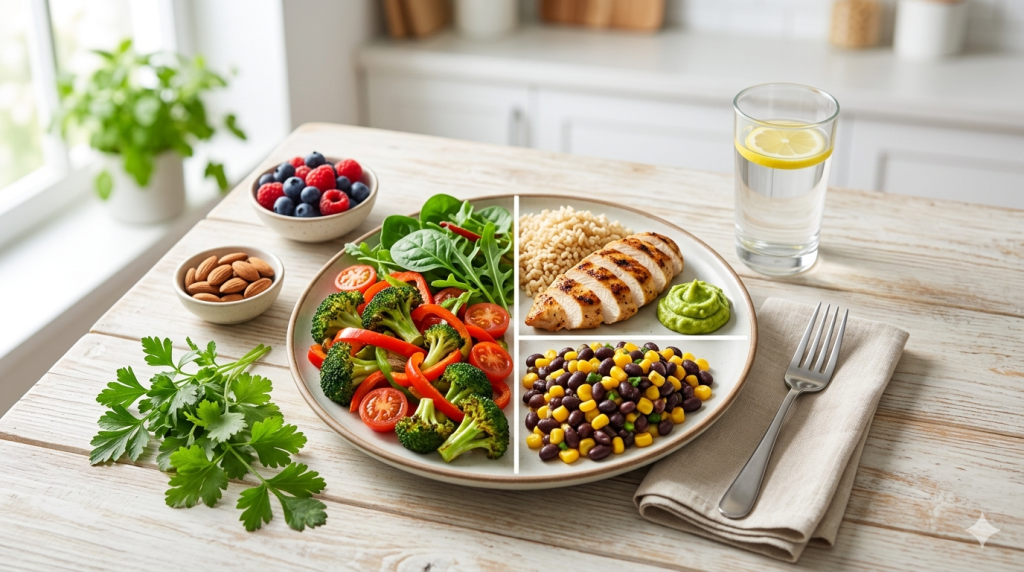
Instead of weighing your chicken breast on a digital scale, RDs recommend the Plate Method. It’s a visual tool that ensures balance without the math:
1/2 Plate: Non-starchy vegetables (broccoli, spinach, peppers).
1/4 Plate: High-quality protein (tofu, fish, lean poultry, or beans).
1/4 Plate: Complex carbohydrates (quinoa, sweet potato, brown rice).
The “Thumb” Rule: Add a thumb-sized portion of healthy fats (avocado, olive oil, or nuts).
This method naturally regulates caloric intake and ensures you’re getting a spectrum of micronutrients that a protein-only focus might ignore.
3. Focus on “Addition,” Not “Subtraction”
The traditional “diet” mindset is built on restriction: no sugar, no carbs, no dairy. This often leads to a “binge-and-restrict” cycle that damages your relationship with food.
The Inclusion Mindset
Dietitians are now advocating for Nutrition by Addition. Instead of looking at a slice of pizza and thinking about what to take away, ask yourself: “What can I add to this to make it more nutritionally complete?”
Pizza night? Add a massive side salad or top the pizza with extra veggies.
Morning yogurt? Stir in some chia seeds and berries.
Pasta? Toss in a handful of spinach or some white beans.
By focusing on what you can add, you increase satiety and nutrient density without the psychological “deprivation” that causes most diets to fail.
4. Tune Into Your “Internal Wisdom” (Intuitive Eating)
In a world of apps and wearable tech telling us when we’ve burned enough calories or eaten enough “points,” we’ve lost touch with our body’s natural hunger and fullness cues.
Honoring Hunger
Eating “better” isn’t just about the food on the plate; it’s about the behavior around the meal.
Eat without distraction: Turn off the TV and put away the phone. This allows your brain to register the “leptin” signal (the hormone that tells you you’re full).
Check the Hunger Scale: On a scale of 1–10, try to start eating when you’re at a 3 (hungry but not ravenous) and stop when you’re at a 7 (satisfied, not stuffed).
Hydrate first: Often, thirst is mistaken for hunger. A glass of water before a meal can help you distinguish between the two.
The Reality Check: Why “Maxxing” Often Fails
The problem with “maxxing” (whether it’s protein, fiber, or vitamins) is that it treats the human body like a closed system that only responds to volume. In reality:
Bioavailability Matters: Eating 100g of protein in one sitting doesn’t mean your body absorbs it all. Most research suggests the body can only effectively use $25-35$ grams for muscle protein synthesis at one time.
Fiber Overload is Real: Jumping from 10g to 50g of fiber overnight won’t make you a “health god”—it will likely cause significant GI distress, bloating, and cramping.
Mental Health is Health: If your diet makes you anxious at social gatherings because you can’t track the macros, the “health” benefits of the food are being offset by the “harm” of the stress.
Conclusion: Simplicity is the Ultimate Sophistication
Improving your diet doesn’t require a degree in nutritional science or a subscription to a tracking app. By shifting your focus from maximums to variety, balance, addition, and intuition, you create a lifestyle that is not only healthier for your body but sustainable for your mind.
FAQ
Q: Is “protein-maxxing” dangerous?
A: For most healthy individuals, high protein isn’t “dangerous,” but it’s often inefficient. Excessive protein is either burned for energy or stored as fat, and it can put unnecessary strain on those with underlying kidney issues.
Q: How do I know if I’m getting enough fiber without tracking?
A: Look at your plate. If at least half of your meals throughout the day consist of colorful plants (fruits/veggies) and you incorporate whole grains, you are likely hitting your targets naturally.
Q: Can I still lose weight without tracking macros?
A: Absolutely. Many people find that by focusing on “adding” fiber and protein (The Addition Mindset) and using the Plate Method, they naturally feel fuller on fewer calories, leading to weight loss without the stress of counting every gram.
Q: Does “plant variety” include frozen or canned goods?
A: Yes! Frozen vegetables, canned beans (rinsed), and dried spices all count toward your “30 plants a week” goal. They are often just as nutritious—and much more affordable—than fresh alternatives.