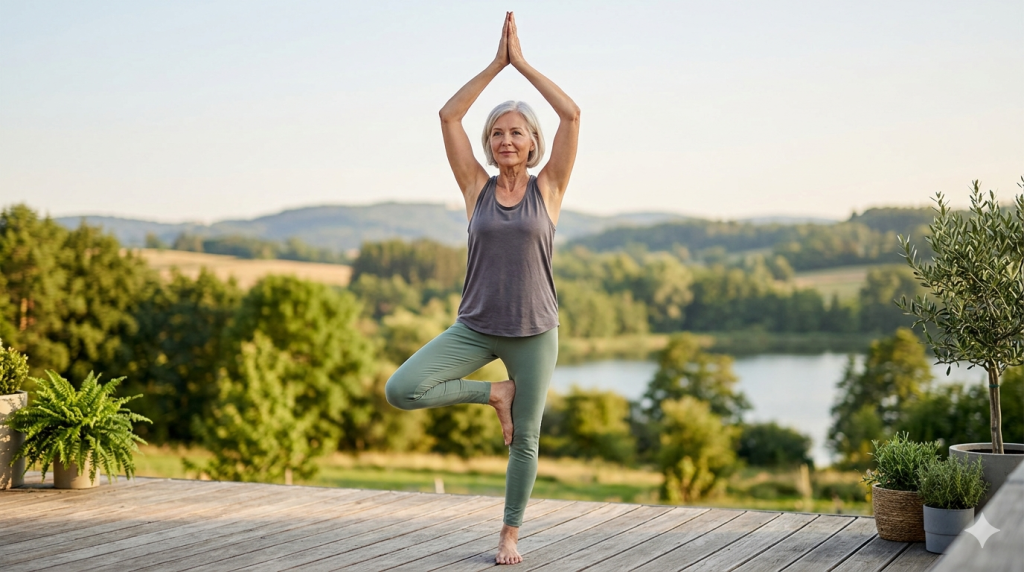
Balance is often something we take for granted until it begins to slip away. For mature practitioners, maintaining stability is not just a fitness goal—it is a vital component of longevity, independence, and physical safety.
In the world of holistic fitness, balance is far more than just standing on one leg. It is a complex interplay between muscular strength, sensory input, and mental focus. Amanda York, a seasoned yoga instructor with over 15 years of experience, has observed a recurring pattern among her older students: a growing hesitation in movement caused by the fear of falling.
However, York asserts that this trend is reversible. By integrating specific standing postures into a daily routine, seniors can recalibrate their vestibular systems, strengthen their foundations, and reclaim the freedom of movement.
Why Balance Becomes a Critical Metric as We Age
Aging brings inevitable physiological changes. Sarcopenia (the loss of muscle mass) and a decrease in bone density are common, but the decline in proprioception—the body’s ability to sense its position in space—is often what leads to injury. According to the CDC, falls are the leading cause of injury-related visits to the emergency room for adults over 65.
Yoga serves as an ideal intervention because it addresses the three pillars of stability:
Core Integration: The muscles surrounding the spine and pelvis act as a stabilizer for every movement.
Ankle and Foot Mobility: Your feet are your “tires.” If the ankles are stiff or the arches are weak, the entire structure above becomes unstable.
Neuroplasticity: Balancing poses force the brain to create new neural pathways as it constantly micro-adjusts to maintain equilibrium.
1. Tree Pose (Vrksasana): The Foundation of Focus
The Tree Pose is the gold standard for unilateral (one-sided) balance. It teaches the body how to distribute weight efficiently while calming the nervous system through focused breathing.
How to Perform it Safely:
Stand tall in Mountain Pose (Tadasana), with your feet hip-width apart.
Shift your weight onto your left leg, ensuring you don’t “dump” into the hip. Engage your glutes.
Slowly lift your right foot. Place the sole of the foot on your inner left ankle (as a kickstand), your calf, or your inner thigh.
Safety Critical: Never place your foot directly against the side of your knee joint, as this creates lateral pressure that can damage ligaments.
Bring your hands to a prayer position at your chest or reach them toward the ceiling like branches.
Find a “Drishti”—a non-moving point on the wall or floor—to lock your gaze.
The Benefit for Seniors:
Tree Pose strengthens the “intrinsic muscles” of the feet and the stabilizers of the hip. For mature students, using a wall for light support allows them to reap the strengthening benefits without the high-risk anxiety of a fall.
2. Warrior III (Virabhadrasana III): Building Functional Power
While Tree Pose is a vertical challenge, Warrior III introduces a horizontal challenge. This pose mimics functional movements like reaching forward or stepping over obstacles.
How to Perform it Safely:
Start in a high lunge with your right foot forward.
Lean your torso forward, shifting your weight into your front leg.
Slowly lift your back (left) leg until it is parallel to the floor, while simultaneously lowering your torso.
Your body should form a “T” shape. Keep your hips “square”—meaning both hip bones should point toward the mat.
Reach your arms forward for a challenge, or keep them by your sides (airplane wings) for better stability.
The Benefit for Seniors:
Warrior III is an incredible “posterior chain” builder. It strengthens the hamstrings, glutes, and lower back. By forcing the standing leg to micro-wobble, it trains the ankle to react quickly to uneven surfaces in the real world, such as cracked sidewalks or plush carpeting.
3. Half Moon Pose (Ardha Chandrasana): Enhancing Spatial Awareness
This is a more advanced posture that combines balance with a lateral opening of the torso. It is particularly effective for improving hip mobility, which is often a “stuck” area for older adults.
How to Perform it Safely:
From a standing position, turn your right foot out 90 degrees.
Reach your right hand down toward the floor or, preferably, a Yoga Block placed about 12 inches in front of your toes.
Lift your left leg until it is parallel to the floor.
Unlike Warrior III, you want to stack your hips. Peel your left hip open so it sits directly above the right.
Extend your left arm toward the sky and, if comfortable, turn your gaze sideways.
The Benefit for Seniors:
Half Moon Pose helps correct the “shuffling” gait often seen in seniors by strengthening the abductors (the muscles on the outside of the hip). These muscles are essential for side-to-side stability. Using a block is highly recommended here to prevent straining the lower back.
The Mind-Body Connection: Stability Beyond the Mat
Amanda York often tells her students, “If the mind is busy, the body will wobble.”
One of the most profound benefits of yoga for the mature population is the reduction of “fear-avoidance” behavior. When someone is afraid of falling, they move less. Moving less leads to weaker muscles, which actually increases the risk of falling.
Yoga breaks this cycle. By practicing these poses in a controlled environment, students learn that a “wobble” is just information, not a failure. They learn how to catch themselves, how to breathe through instability, and how to stand tall with poise.
Conclusion
Improving balance is a marathon, not a sprint. For seniors, the goal isn’t to perform a perfect “Instagrammable” pose, but to build a body that is resilient and a mind that is confident. By dedicating just 10 to 15 minutes a day to these three standing postures, you are investing in your future mobility. Remember: the strongest tree is not the one that never moves, but the one that knows how to sway in the wind without breaking.
Frequently Asked Questions (FAQ)
1. How often should I practice these poses?
For noticeable results in balance and muscle tone, consistency is key. Aim for at least 3 to 5 times a week. Daily practice of even just the Tree Pose can yield significant improvements in neurological coordination within a month.
2. Is it okay to use a chair or wall for support?
Absolutely. In fact, it is encouraged. Using a wall allows you to focus on muscle engagement and alignment without the stress of falling. As you get stronger, you can transition to “finger-tip” support, and eventually, no support at all.
3. I have vertigo/dizziness issues. Can I still do yoga?
Yes, but you should consult with a physician first. When practicing, keep your gaze (Drishti) on the floor rather than the ceiling, as looking up can sometimes trigger dizziness. Move between poses slowly to allow your blood pressure to regulate.
4. What equipment do I need to start?
A non-slip yoga mat is essential for safety. For seniors, a Yoga Block is highly recommended for Half Moon Pose, and a sturdy, non-rolling chair can serve as a great prop for balance.
5. Will this help with my back pain?
Often, yes. Many balance issues stem from a weak core. As these poses strengthen your abdominal and spinal muscles, you may find that your posture improves and chronic lower back tension decreases.