As we age, the conversation about fitness often shifts from “look good” to “live well.” In our 20s, the goal might have been visible six-packs; in our 60s, the ultimate achievement is preventing a fall that could rewrite the script of our golden years. For older adults, balance is not just a skill—it is an insurance policy. While muscle mass (the focus of typical strength routines) is vital, dynamic stability—the body’s ability to maintain its center of gravity during movement—is the crucial “next step” in longevity medicine.
The reality of aging involves small, progressive losses: of fast-twitch muscle fibers, of neurological reaction time, and of proprioception (knowing where your body is in space). These factors compound to make us feel less steady, particularly when moving on uneven ground.
The good news is that stability is a highly trainable physical quality. You do not need complex agility ladders or specialized balance boards. In fact, adding a external load—like a single dumbbell—challenges your core stability far more than bodyweight exercises alone, forcing your stabilizing muscles to activate in an “anti-rotational” way. This routine moves beyond basic strength and focuses on stability in motion.
The Dynamic Stability Workout: One Dumbbell, Real-World Strength
This five-move routine is designed to improve coordination, reactivate core stability, and build functional lower body strength that translates directly to navigating stairs, sidewalks, and the everyday risks of movement.
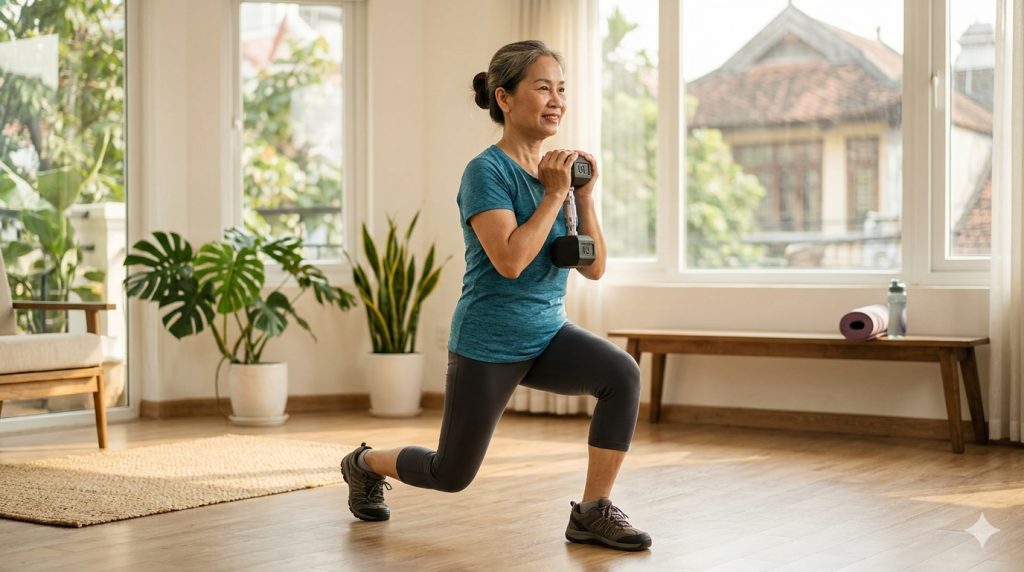
1. Offset Dumbbell Lunge (or Split Squat)
The lunge is a movement that requires excellent dynamic stability. By holding a single dumbbell on just one side of your body (the “offset” load), you force your core to fire more aggressively to prevent you from toppling over.
The Benefit: Strengthens the quads and glutes, enhances hip stability, and improves side-to-side balance.
The Pro Tip: If a traditional walking lunge is too unstable, start with a “Split Squat”: position your feet and then lower yourself, keeping the load on the same side.
2. Three-Point Stance Single-Arm Row
This variation of the row is less about building massive back muscles and more about core activation. Instead of supporting yourself on a bench, support yourself with one hand on a wall or a very sturdy table, creating a “tripod” base with your two feet.
The Benefit: Targets the upper back (good for posture) while demanding an “anti-rotation” challenge from your oblique and deep core muscles.
The Pro Tip: Keep your hips square to the ground. If your opposite hip raises, you are rotating, not stabilizing.
3. Single-Leg Dumbbell Romanian Deadlift (RDL)
This is the ultimate balance challenge. You will stand on one leg, with a slight bend in the knee, and hinge your hips back, letting the dumbbell drift down your leg toward the floor.
The Benefit: Directly targets proprioception and strengthens the muscles of the foot and ankle, which are essential for correcting imbalance before a fall.
The Pro Tip: You do not need a heavy weight. Start bodyweight only, touching a wall for balance, and progress slowly. Keep your core tight.
4. The Kettlebell/Dumbbell Goblet Carry (or “Pike-Up Walk”)
This move involves holding a single dumbbell in the goblet position (as in the squat) but instead of squatting, you walk forward slowly.
The Benefit: Challenges vertical spinal stability and core strength while in motion. Holding a load at your chest prevents slouching.
The Pro Tip: Make this a “Pike-Up Walk” by deliberately raising your knee high with each step, creating momentary single-leg instability that you must master.
5. Halo (Using a Dumbbell)
Hold a single dumbbell horizontally by its “bells” at your chest. Slowly circle the dumbbell around your head, close to your scalp, keeping your torso rock-solid and still.
The Benefit: Improves shoulder mobility and requires immense, dynamic core stability as the center of mass shifts constantly around your body.
The Pro Tip: Do not lean or sway. Your arms move; your torso remains a fortress.
Key Principles for Stability Training in Your 60s
Unlike muscle growth, which can handle heavy overload, stability training requires precision and nervous system engagement.
Quality Over Quantity: The most important factor in a stability exercise is control. If you are wobbling wildly or rushing the move, you are not building stability. Slower movement forces your muscles to fire with more coordination.
Train When Fresh: Balance and coordination are neurological skills. Do these exercises at the beginning of your workout, not at the end when your nervous system is fatigued.
Focus Your Gaze: Find a stationary point 5–10 feet in front of you on the ground and lock your eyes on it. This “visual anchor” provides extra feedback to your brain about your position.
Conclusion: Stability is the Key to True Fitness Longevity
When we think about physical freedom after 60, it’s not just about having the strength to carry a heavy box; it’s about having the confidence to navigate the world without fear. Building dynamic stability is an investment that pays immediate dividends in safety, mobility, and confidence. This one-dumbbell routine is your weekly commitment to a body that isn’t just strong, but unshakeably stable. It’s never too late to start building your foundation.
Frequently Asked Questions (FAQ)
Q: I get dizzy easily. Is this workout safe for me? A: If you have issues with dizziness or a vestibular disorder (like vertigo), you should speak to your doctor or a vestibular therapist before trying balance exercises. They can often provide specialized treatments or modifications.
Q: How do I know if the weight is too heavy for a stability exercise? A: If you cannot complete the full range of motion with complete control (e.g., if you are shaking uncontrollably, rushing, or using momentum), the weight is too heavy. The point of stability work is stability, not maximal strength.
Q: My feet hurt when I do balance work. Is that normal? A: Yes! Your feet and ankles contain countless small stabilizing muscles that you are now actively using. Think of it like soreness from any other workout. You are strengthening your foundational support.