For millions of high-achieving professionals, the bedroom has become a secondary office. We lie down with the intention of resting, but our brains remain “online,” processing the day’s micro-stressors and tomorrow’s deadlines. While supplements like melatonin have spiked in popularity, they often act as a chemical band-aid rather than addressing the root cause of sleeplessness: a hyper-aroused nervous system.
Enter the 4-7-8 breathing technique. Far from being just another “yoga trick,” this method is grounded in the mechanics of biological feedback loops. Here is why this specific rhythm is becoming the gold standard for non-pharmacological sleep intervention.
The Biology of “Tired but Wired”
The feeling of being exhausted yet unable to sleep is often a symptom of autonomic dysregulation. Your body’s “accelerator” (the Sympathetic Nervous System) is stuck, even though your brain knows it is time to park.
When you are in this state, your breathing becomes shallow and rapid. This tells your brain that you are under threat, triggering a cycle of cortisol production. To break this cycle, you must manually engage the “brakes”—the Parasympathetic Nervous System.
How 4-7-8 Reconfigures Your Internal Clock
The 4-7-8 method, popularized by Dr. Andrew Weil, is a rhythmic pattern that forces the body to reset its oxygen-to-carbon dioxide ratio.
The Inhalation (4 Seconds): Breathing in quietly through the nose draws oxygen deep into the lower lobes of the lungs, where the majority of blood flow occurs.
The Breath Retention (7 Seconds): This is the crucial “pause.” Holding the breath increases the pressure in the chest, stimulating the vagus nerve and allowing more oxygen to be absorbed into the bloodstream, which has a natural sedative effect on the heart.
The Forced Exhalation (8 Seconds): Exhaling for double the time of the inhale is the key to relaxation. It ensures you expel a maximum amount of carbon dioxide, which in turn signals the brain to lower the heart rate and drop blood pressure.
The “Vagus Nerve” Connection
The real hero of this technique is the Vagus Nerve. It acts as the primary highway between the brain and the vital organs. By practicing the 4-7-8 rhythm, you are essentially “massaging” this nerve.
Research suggests that stimulating the vagus nerve through deep, rhythmic breathing can lower proinflammatory cytokines—the chemicals linked to stress and chronic inflammation. This makes the 4-7-8 technique not just a sleep aid, but a holistic health practice.
Step-by-Step Implementation for Maximum Efficacy
To get the best results, consistency is more important than duration. Follow this routine for the next 21 days:
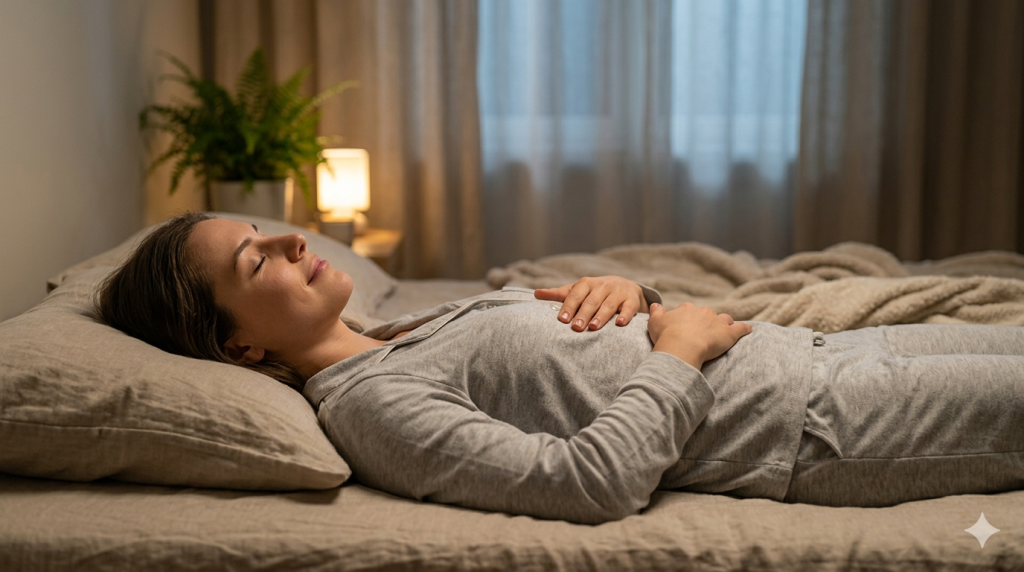
Posture: Lie flat on your back with your hands by your sides, palms facing up.
The Tongue Position: Keep the tip of your tongue against the tissue ridge behind your upper front teeth. This is a “grounding” position that helps keep the airway open and stable.
The “Whoosh”: When you exhale for 8 seconds, do so through your mouth, making a soft whooshing sound. This audible feedback helps focus the mind away from intrusive thoughts.
Volume: Do not over-breathe. Keep the inhalations quiet and the exhalations controlled.
Why It Beats Traditional Meditation
Many people struggle with traditional meditation because “trying not to think” creates more stress. The 4-7-8 method is active. It gives the mind a specific mathematical task (counting) and the body a physical task (breathing). This dual-engagement makes it much harder for the “monkey mind” to drift back to work emails or social anxieties.
FAQ: Expert Insights on 4-7-8 Breathwork
Is the 4-7-8 technique safe for everyone? Most people find it very safe. However, if you have underlying cardiovascular issues or severe lung disease, check with a doctor first. If you feel lightheaded, simply slow down the count or take a break between cycles.
Can I do this while sitting at my desk? Absolutely. While it is a primary tool for sleep, using it during a high-stress workday can lower your baseline cortisol levels, making it easier to wind down once you finally get home.
Why is the 7-second hold so difficult at first? If you are used to shallow breathing, holding your breath can feel unnatural. Your body is adapted to a state of “air hunger.” As your lung capacity improves and your nervous system calms, the 7-second hold will become the most relaxing part of the cycle.
Does it matter if I count faster or slower? The absolute time isn’t as important as the ratio. If you find 4-7-8 too long, you can speed up the counting as long as the ratio (1:1.75:2) remains consistent.
How many rounds should I perform? Start with 4 rounds twice a day. Do not exceed 8 rounds at a single time for the first month. Over time, your body will develop a “muscle memory” for this state of relaxation.
Conclusion
Sleep is not a passive event; it is an active biological process that requires the right internal environment. By mastering the 4-7-8 breathing technique, you stop fighting your biology and start working with it. It is a free, fast, and remarkably effective way to shut down the noise of the modern world and return to the restorative rest your body deserves.