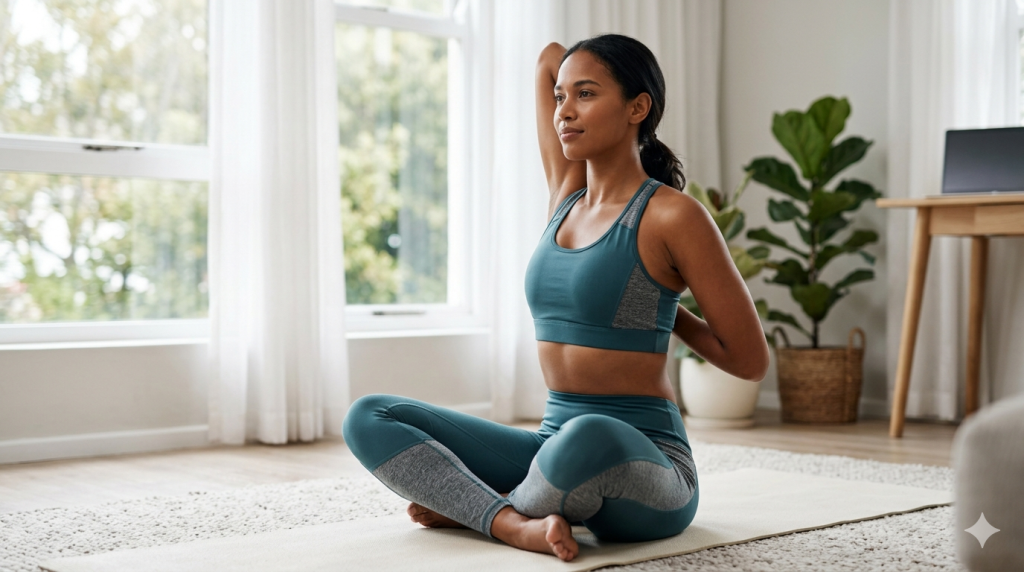
In today’s digital era, the “office slouch” has evolved from a bad habit into a widespread physical ailment. Whether you are navigating a high-pressure corporate role or managing a growing home business, hours spent hunched over laptops and mobile devices create a perfect storm for musculoskeletal issues. This sedentary pattern typically results in “Tech Neck,” rounded shoulders, and a compressed lumbar spine—conditions that drain your energy and lead to long-term chronic pain.
The good news is that you don’t need hours at the gym to reverse these effects. Leading yoga practitioners suggest that targeted, functional movements can effectively “reset” the body’s alignment. By focusing on opening the chest, lengthening the hip flexors, and mobilizing the spine, you can undo a full day of sitting in just a few minutes.
Here are five essential yoga poses designed to counteract office-related strain and help you maintain a professional, healthy posture.
1. The Cat-Cow Sequence (Marjaryasana-Bitilasana)
Often called the “spinal tune-up,” this rhythmic movement is the gold standard for restoring mobility to a stiff back.
The Benefit: Sitting causes the spinal discs to compress and the surrounding muscles to become rigid. Cat-Cow gently wakes up the entire spine, improving circulation and synovial fluid flow between the vertebrae.
The Execution:
Begin on all fours in a tabletop position with a neutral spine.
Inhale (Cow): Drop your abdomen toward the mat, lift your sit bones, and gaze forward, feeling your collarbones broaden.
Exhale (Cat): Round your spine toward the ceiling, tuck your chin to your chest, and push away from the floor.
Repetitions: Flow through 5–10 cycles, matching each movement to a full breath.
2. Low Lunge with Lateral Stretch (Anjaneyasana Variation)
Sitting for prolonged periods causes the hip flexors (psoas) to remain in a shortened state, which eventually pulls on the lower back and creates instability.
The Benefit: This pose creates a deep release in the hips while the side-bend element stretches the intercostal muscles, helping you breathe more deeply and stand taller.
The Execution:
From a standing or tabletop position, step your right foot forward into a lunge.
Lower your left knee to the ground (use a cushion if needed).
Reach both arms up, grab your left wrist with your right hand, and lean gently to the right.
Duration: Hold for 30 seconds per side.
3. Bridge Pose (Setu Bandha Sarvangasana)
The “slouch” is essentially a collapse of the front body and a weakening of the back body. Bridge Pose is the structural antidote.
The Benefit: It “wakes up” the glutes and hamstrings—muscles that often go dormant during office hours—while simultaneously creating a massive opening in the chest and front shoulders.
The Execution:
Lie on your back with knees bent and feet flat, hip-width apart.
Press your heels into the floor and lift your pelvis toward the ceiling.
Interlace your fingers underneath your back and walk your shoulder blades inward for maximum chest expansion.
Repetitions: Hold for 30 seconds, breathe deeply into the belly, and lower slowly.
4. “Cactus” Arms (Chest Opener)
Constant typing forces the shoulders to rotate internally, tightening the pectoral muscles and dragging the head forward.
The Benefit: This simple movement manually resets the shoulder girdle and stretches the pectoralis minor, which is the primary muscle responsible for rounded shoulders.
The Execution:
This can be done while sitting at your desk or standing.
Reach your arms overhead on an inhale.
On the exhale, bend your elbows to 90 degrees, pulling them slightly back and down until you feel a stretch across your chest.
Tip: Think of lifting your sternum (breastbone) toward the ceiling as you pull the elbows back.
5. Warrior I (Virabhadrasana I)
For a total body realignment that builds strength and focus, Warrior I is the ideal “power pose” to break up the workday.
The Benefit: It combines a hip flexor stretch, spinal extension, and shoulder mobilization. It trains your body to find length and height, effectively fighting the “gravity” of the desk.
The Execution:
Step one foot back about 3–4 feet, turning the back heel in at a 45-degree angle.
Bend the front knee directly over the ankle.
Sweep the arms up, palms facing each other, and look slightly upward.
Duration: Hold for 5 deep breaths, focusing on grounding through the feet.
Conclusion: Consistency Over Intensity
Improving your posture doesn’t require a lifestyle overhaul. By performing these five poses—even just a few times a week—you can drastically reduce the risk of chronic back pain and fatigue. Remember, the goal is to create “micro-breaks” for your body. A few minutes of mindful movement today is the best investment you can make for your long-term physical health.
Frequently Asked Questions (FAQ)
Q: I feel very stiff; will these poses be too difficult? A: Not at all. Yoga is about meeting your body where it is. If a pose feels too intense, reduce the range of motion. Use a chair for support during lunges or keep your hands on your hips during Warrior I.
Q: How long until I see improvements in my posture? A: You will likely feel immediate relief in terms of muscle tension. Structural changes in posture usually take 4–6 weeks of consistent practice (3–4 times a week) to become noticeable.
Q: Can I do these in my work clothes? A: Yes! Except for Bridge Pose (which requires lying down), these can all be modified for an office environment. “Cactus Arms” and “Cat-Cow” (can be done seated in a chair) are particularly office-friendly.